AltSql Grows From One Engine to Seven, Each With a Live Demo
A week ago AltSql was one engine. It kept key-value data and time-series readings on a device, answered SQL on a gateway, and copied the same records to both, byte for byte. That engine is now AltSql Core, and six more engines have joined it.
Each new engine takes on a different problem in how devices keep, search and share their data. Each one is a working prototype in a single C file. It has tests and measured results, and a live demo that runs in the browser on the live demo page.
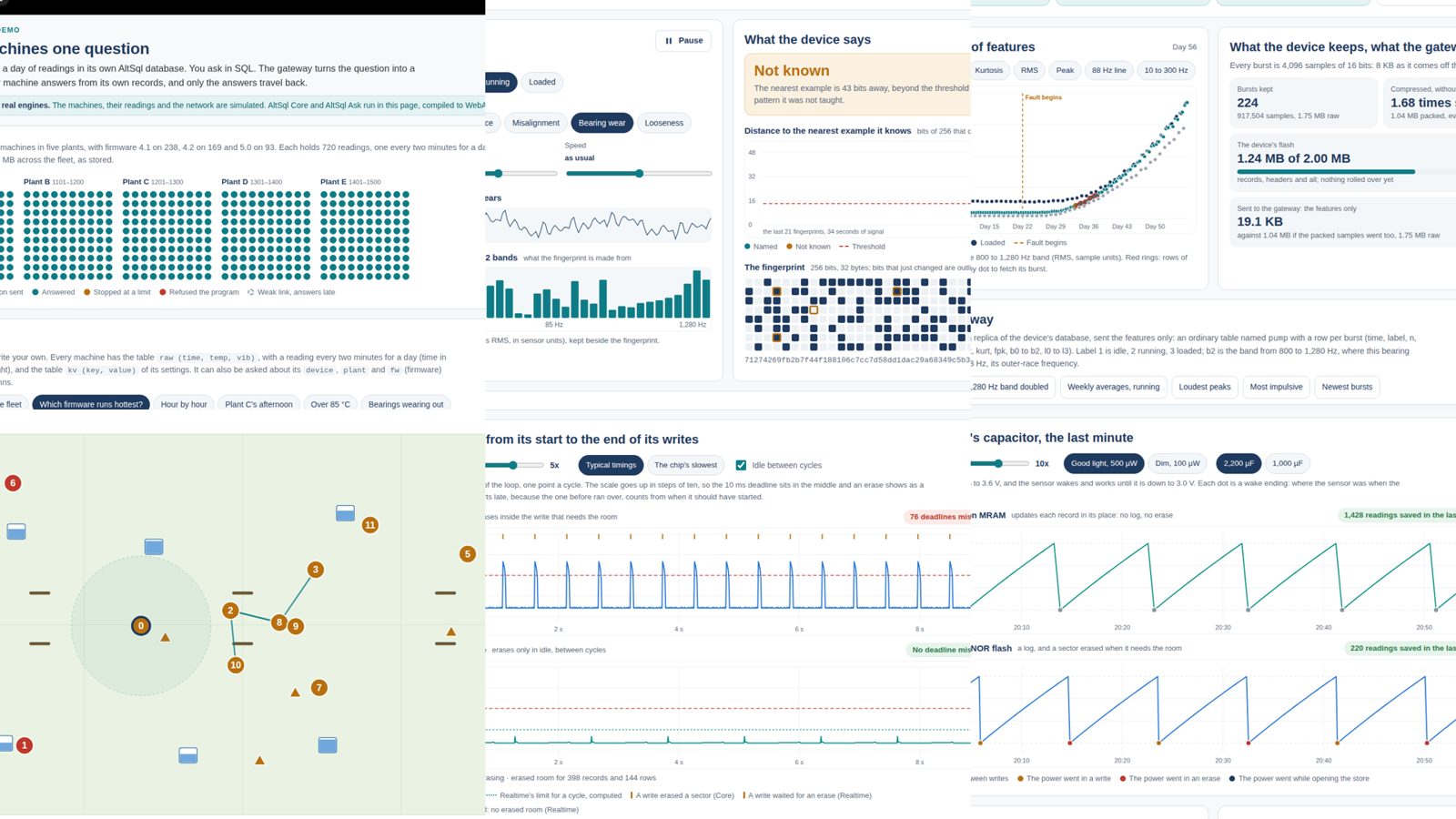
The Seven
- AltSql Core stores key-value pairs and time-series rows on the device and answers SQL on the gateway, with the same records in both places.
- AltSql Ask sends one SQL question to a whole fleet. Every device answers from its own records, and only the answers come back.
- AltSql Vector turns vibration into 32-byte fingerprints, names what a machine is doing by the closest one it was taught, and flags what it was never taught.
- AltSql Wave keeps raw vibration bursts on the device, compressed without losing a bit, and sends the gateway only the figures worth searching.
- AltSql Mesh keeps one shared table on every device of a fleet, with no gateway and no server. Devices catch each other up whenever they meet.
- AltSql Realtime gives a control loop storage where every write has a known limit, worked out before the device runs.
- AltSql Instant is storage for MRAM and FRAM, where a write is kept the moment its call returns.
Why a Family
The engines share one idea. A device should keep its own data and decide for itself. It should keep working when the link drops, act on its own data, send results instead of every raw reading, and use one format from the sensor to the cloud. Each engine applies that idea to a case the first engine did not cover: a whole fleet to question, a motor to listen to, a farm with no signal, a deadline measured in milliseconds, a sensor with no battery.
Four of them share code with Core: Ask, Vector, Wave and Mesh keep their data in it. Instant uses none of Core’s code, but its records are Core’s, byte for byte, so a gateway running Core takes them as they are. Realtime is its own storage layer too, and a device’s flash driver for Core serves it as well.
Where It Stands
Every engine works and is tested on a PC, in simulation, and Vector and Wave on recorded vibration as well. None of them has run on a microcontroller yet, and no figure on this site comes from one. Running on real boards is the Beta.
An eighth engine, AltSql Private, would give a gateway totals across devices without their individual readings. It is on hold until an outside security review.
The engines page has a paragraph on each, with the figures the Alpha measured. The posts that follow take the new engines one at a time.