AltSql Vector Teaches a Device What a Healthy Motor Sounds Like, in 32-Byte Fingerprints
A vibration sensor on a motor hears a lot. Most of it is the motor doing its job. The useful part is the moment the sound changes into something new, like a bearing starting to wear. Sending every sample to a server to find that moment costs bandwidth the device often does not have.
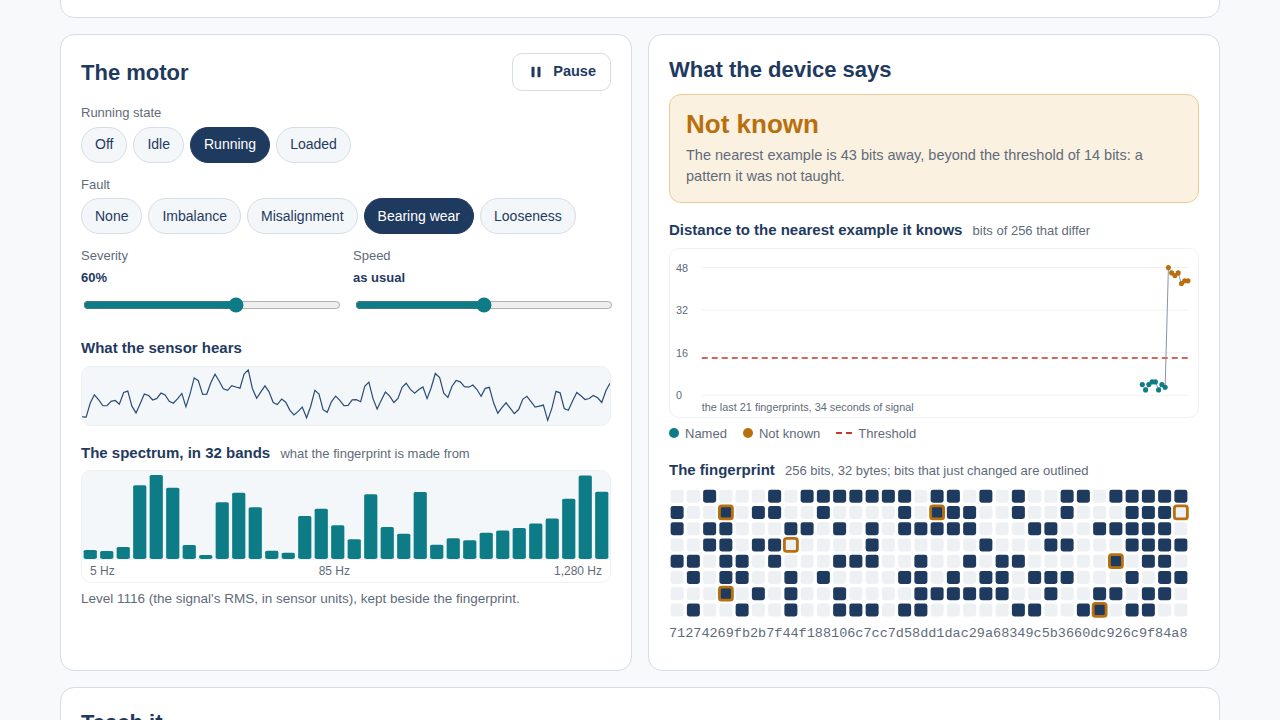
AltSql Vector lets the device do the listening. Every 1.6 seconds it splits what it hears into 32 frequency bands and turns that into a fingerprint of 256 bits, which is 32 bytes. It keeps fingerprints of the states it has been taught, such as idle, running and loaded. For each new fingerprint it finds the closest one it knows and names the state. When nothing it knows is close enough, it flags the pattern as one it was never taught.
Teaching happens on the spot. Name a new pattern, and from then on the device recognizes it. The fingerprints it was taught, and the history of what it heard and what it called it, are kept in the device’s AltSql Core database.
What the Alpha Found
The test that matters most used real recordings from a public bearing data set. Taught only a healthy bearing, the Alpha flagged every fault fingerprint in nine fault recordings, at each of two loads. It flagged none of the 55 normal ones, though with so few, a false-alarm rate of a few percent cannot be ruled out.
Try It
Open the AltSql Vector demo. Teach it the healthy motor, then give the bearing a fault it has never heard. Name the new pattern and it is known from then on. Last, start a fresh bearing and let it wear out while you watch the distance to the nearest known fingerprint climb.
Where It Stands
AltSql Vector is one C file of 931 lines, built on AltSql Core. It works and is tested in simulation and on recorded vibration, on a PC. It has not yet run on a microcontroller. The motor, its faults and the sensor in the demo are simulated, and the engine is real, compiled to WebAssembly.